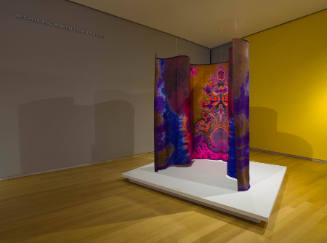
Fabric Vibrations: Tie and Fold-dye Wall Hangings and Environments
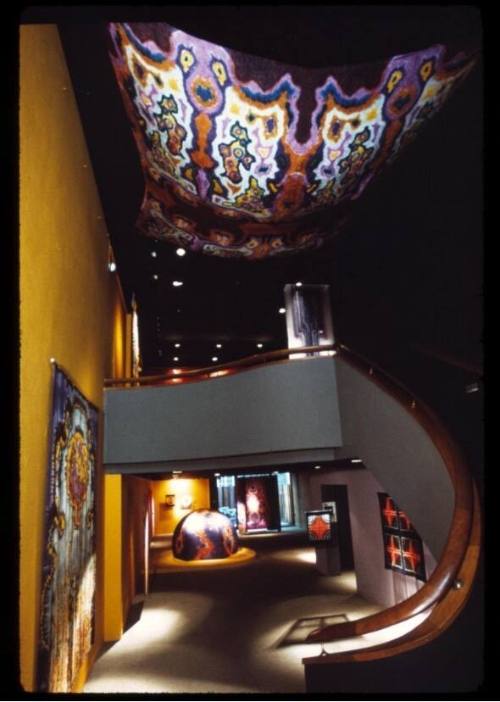
In the 1960s, tie-dye fabrics became a folk art that reflected the era. Tie-dye garments became a staple for a particular counterculture community. Much of this imagery reflected young people's interest in expressing their individuality, sometimes linked to the popular drug culture of the time. Simultaneously, several accomplished fiber artists were creating refined tie-dyed work, motivated by a desire to explore traditional fiber techniques in a new way. In response to the art form’s growing popularity, the Museum of Contemporary Craft (now the Museum of Arts and Design) presented an exhibition to honor the ancient craft of tie-dye and to give visibility to the serious work of contemporary professional fiber artists. Thus, Fabric Variations included a historical section with illustrations of techniques used over time to underscore the craft's pervasiveness. Simultaneously, the exhibition featured the work of artists of the era, such as Chunghi Choo, Marian Clayden, Elizabeth Freeman, Carol Ryoko Funai, Jennifer Lew and Richard Proctor, Multifarious and Quinja Maya, Will and Eileen Richardson, and Zubin.
The Museum of Contemporary Craft (now The Museum of Arts and Design) thanks the artists for their generous cooperation during the organization of this exhibition. A special note of thanks is extended to Milton Sonday, Curator of Textiles at the Cooper-Hewitt Museum of Decorative Arts and Design, for serving as a consultant and for writing the text for the catalog, and to RIT Dyes for preparing the segment devoted to technique.